
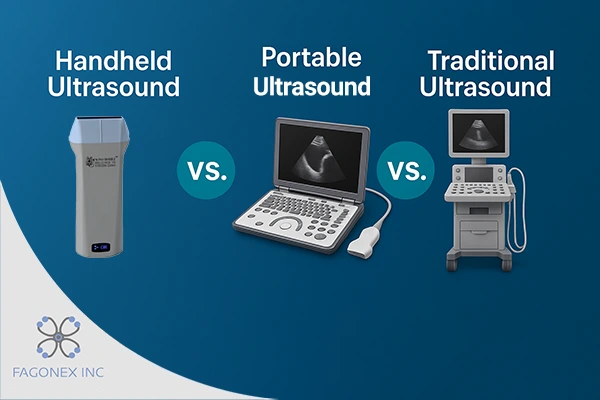
Modern healthcare is undergoing a dramatic transformation. As medical environments shift toward faster diagnostics, point-of-care medicine, and cost-effective workflow, clinicians face a critical question:
Which ultrasound platform delivers the best balance of accuracy, portability, and value?
Is it the classic traditional cart-based machine, the widely used portable laptop-style unit, or the new generation of pocket-sized handheld ultrasound devices such as Sono Mobile™️?
This comprehensive guide breaks down everything you need to know; from imaging performance and workflow differences to cost, applications and future innovation. Whether you’re a clinician, medical student, or healthcare decision-maker, this article will help you choose the right technology for your practice.
Why This Comparison Matters in Modern Healthcare
For decades, traditional cart-based ultrasound systems dominated hospitals. They offered the highest imaging quality, advanced Doppler modes, multi-probe support, and full diagnostic capabilities that made them indispensable in radiology, cardiology, and OB/GYN departments. Their large displays, powerful processors, and comprehensive software suites made them the gold standard for complex examinations and high-volume imaging workflows.
However, clinical needs have changed significantly. Modern healthcare environments now prioritize flexibility, rapid decision-making, and mobility. Today’s clinicians need tools that can move with the patient rather than requiring the patient to be transported to a dedicated imaging room. Hospitals and clinics are also facing increasing pressure to reduce delays, improve patient flow, and support remote or decentralized models of care. As a result, portability, wireless connectivity, quick boot times, and point-of-care accessibility have become essential factors; pushing handheld and portable ultrasound technologies to the forefront of everyday clinical practice. Healthcare environments now need:
- Speed at the bedside
- Point-of-care decision making (POCUS)
- Mobility between departments
- Remote and home-based care
- Telemedicine and digital workflow
- Lower cost diagnostic tools with high ROI
These new clinical demands; faster workflow, bedside decision-making, and greater mobility, played a direct role in shaping the evolution of ultrasound systems over time. Each generation of devices emerged to solve a specific problem or limitation of the previous one.
Traditional Ultrasound (Cart-Based) → Built for the Imaging Department
The earliest and most powerful systems were designed for static, controlled, department-based imaging. Their large footprints, cooling systems, and advanced processing units required them to stay in radiology or sonography suites. These machines were ideal for comprehensive examinations, specialized studies, and high-volume hospital workflows; but they were not designed to move quickly between patients or departments. Their purpose was clear: provide the highest possible image quality in a dedicated room.
Portable Ultrasound (Laptop-Size) → Built for Multi-Department Mobility
As healthcare delivery expanded beyond radiology departments, clinicians needed imaging that could be brought to ICU, emergency rooms, operating rooms, clinics, wards, and even sports medicine settings. This demand led to the rise of laptop-style portable ultrasound machines. They offered a middle ground:
- More compact and easier to transport
- Capable of high-quality imaging
- Flexible enough for different departments
- Still powerful compared to their size
These machines solved the mobility challenge but still required a surface, a cart, or a workstation. Their boot times and cable management also limited real-time rapid scanning.
Handheld Ultrasound (Mobile-Size) → Built for POCUS, Emergency Care, and Rapid Diagnostics
The most recent evolution; handheld ultrasound, was driven by the shift toward point-of-care ultrasound (POCUS), where clinicians need answers instantly, right at the bedside. Emergency physicians, intensivists, family doctors, paramedics, and field clinicians required a device that was:
- Small enough to fit in a pocket
- Always available
- Wireless and cable-free
- Fast to boot
- Easy to disinfect
- Affordable for widespread adoption
Handheld devices meet these demands by providing immediate imaging with AI support, cloud connectivity, and mobile compatibility. They transform the ultrasound from a departmental tool into a personal diagnostic instrument, similar to a stethoscope for the modern clinician.
Understanding these differences helps clinicians select devices that improve both workflow efficiency and clinical outcomes.
Overview of Traditional Ultrasound (Cart-Based Systems)
Traditional ultrasound machines; the large cart-based systems, set the gold standard for diagnostic imaging. These systems commonly include multiple transducers, advanced beamforming technology, high-resolution monitors, and extensive software packages.
Key Advantages
Superior Imaging Quality
Their size allows for larger hardware components, high-powered processors, and advanced signal processing.
Traditional units deliver:
- Higher pixel density
- Stronger Doppler sensitivity
- Deeper penetration for cardiac, OB/GYN, and abdominal cases
- Reduced noise and enhanced tissue contrast
Multi-Probe & Specialty Support
Most systems support 3–5 probes simultaneously, ideal for:
- Cardiology
- Obstetrics
- Radiology
- MSK
- Vascular
- Interventional procedures
Full Diagnostic Suite
Cart systems offer:
- 3D/4D imaging
- Elastography
- Tissue harmonic imaging
- Contrast-enhanced ultrasound
- Advanced M-mode for cardiology
Best for High-Volume Departments
Radiology departments, fertility clinics, large OB/GYN practices, and cardiology labs typically rely on traditional ultrasound.
Limitations
- Very high cost: $40,000–$200,000
- Not mobile-friendly
- Slow workflow
- Long learning curve
- Difficult to sanitize between patients
- Not ideal for emergency or field diagnostics
Cart-based ultrasound remains the powerhouse for deep imaging and subspecialty care, but not all environments need such a large system. Many clinical settings; such as busy emergency rooms, outpatient clinics, rural practices, and bedside care units, require speed, portability, and immediate access rather than full-size equipment. In these scenarios, a lighter, more flexible ultrasound solution can deliver faster workflows, reduce patient transfer, and support real-time decision-making. As a result, healthcare providers increasingly turn to portable and handheld systems that match their daily operational needs.
Overview of Portable Ultrasound (Laptop-Style Machines)
Portable ultrasound systems emerged as the perfect middle-ground solution.
They are designed as laptop-sized units, typically weighing 3–7 kg, and offer a blend of powerful imaging capabilities with better mobility.
Key Advantages
Balance of Power and Portability
Portable ultrasounds deliver stronger performance than handheld units while remaining far more mobile than full cart systems. They are excellent for:
- Internal medicine
- Emergency rooms
- Anesthesia
- ICU
- Orthopedics
- Family medicine
Good Depth and Resolution
While slightly lower than cart systems, laptop units offer:
- Excellent linear and convex imaging
- Reliable Doppler modes
- Sufficient penetration for abdominal and OB applications
Multi-Probe Flexibility
Most portable units support 2–3 probes, making them practical for multi-purpose clinics.
Reasonable Cost
Typically $8,000–$25,000, positioning them between handheld and cart.
Limitations
- Not truly pocket-sized
- Requires a surface or stand
- May have slower boot times
- Lower processing power than carts
- Less durable than handheld units
Portable ultrasound represents the “performance vs. convenience” midpoint in today’s market, ideal for clinics wanting flexibility without the price tag of large systems. These laptop-style units deliver strong imaging quality, multiple probe options, and reliable battery-powered operation—making them suitable for emergency departments, rural hospitals, specialty clinics, and mobile medical services. They offer enough power for detailed assessments while remaining light enough to move room-to-room or between facilities. For many healthcare providers, portable ultrasound strikes the perfect balance between capability, mobility, and cost-efficiency.
Overview of Handheld Ultrasound Machines (Mobile Size)
The handheld ultrasound segment; powered by brands like Sono Mobile™️, has revolutionized modern diagnostics.
These pocket-sized devices allow clinicians to scan from anywhere, including:
- Bedside
- Ambulance
- Field environments
- Rural clinics
- Home care
- Disaster and military medicine
- Fast assessments in ER and ICU
Key Advantages
Extreme Portability
Handheld probes weigh 300–450 grams and fit in a coat pocket.
You can scan:
- At the bedside
- While walking
- During procedures
- During home visits
Instant Boot and Rapid Imaging
Most handheld devices turn on in under 2 seconds.
3. AI-Enhanced Imaging
Modern handheld scanners include:
- Auto-image optimization
- AI cardiac border detection
- Auto bladder volume
- Auto fetal measurements
- Auto vessel tracking
These features allow younger clinicians and medical students to learn POCUS rapidly.
Wireless Connectivity
Sono Mobile™️ devices stream images directly to:
- Smartphones
- Tablets and Laptops
- Hospital PACS
- Cloud servers
- EMR systems
Lowest Cost
Typically $2,000–$6,000, significantly cheaper than laptop and cart-based machines.
Perfect for POCUS
Handheld ultrasound is now standard in:
- Emergency medicine
- ICU and anesthesia
- Primary care and internal medicine
- MSK and sports medicine
- Urology and Nephrology
- OB fast scans
- Neurology
- Pulmonary
- Veterinary medicine (mobile fieldwork)
Limitations
- Image quality slightly lower than cart systems
- Not ideal for complex imaging like obstetric or advanced cardiology
Despite limitations, handheld ultrasound is now a critical tool for rapid diagnostics and bedside decision-making. Its compact size, instant boot-up, and wireless connectivity allow clinicians to perform immediate assessments without moving the patient. This capability is particularly valuable in emergency rooms, intensive care units, and remote or rural settings where traditional machines are impractical. Handheld devices also support real-time collaboration, telemedicine, and AI-assisted measurements, enabling faster, more accurate clinical decisions and improving patient outcomes while streamlining workflow efficiency across diverse medical environments.
Differences Between Handheld, Portable, and Traditional Cart-Based Ultrasound Machines
Below is a full professional comparison examining all technical and workflow factors.
Image Quality
- Traditional: Highest quality, advanced Doppler, deep penetration
- Portable: Very good, near-cart quality for many applications
- Handheld: Excellent for abdominal and linear imaging, limited in cardiac
Winner: Traditional
Portability
- Traditional: Poor (heavy, not mobile)
- Portable: Moderate mobility
- Handheld: Exceptional, perfect for POCUS and remote care
Winner: Handheld
Cost
- Traditional: $40k–$200k
- Portable: $8k–$25k
- Handheld (Sono Mobile™️): $2k–$6k
Winner: Handheld
Workflow Speed
- Traditional: Slower, room setup needed
- Portable: Medium
- Handheld: Fastest; instant scanning
Winner: Handheld
Clinical Use Cases
Traditional
- Cardiology labs
- OB/GYN clinics
- Radiology
- High-volume hospitals
Portable
- Emergency departments
- Anesthesia
- Internal medicine
- Orthopedics
- Vascular labs
Handheld (Sono Mobile™️)
- ICU/ER
- Primary care
- Clinic Visit
- Family medicine
- Field medicine
- Ambulatory care
- Home visits
- Rural & remote settings
- Medical students learning POCUS
Maintenance & Durability
- Traditional: Complex, expensive repairs
- Portable: Moderate maintenance
- Handheld: Low maintenance, highly durable, fewer moving parts
Winner: Handheld
AI Integration and Connectivity
Handheld systems, including Sono Mobile™️, lead in:
- AI measurement tools
- Wireless connectivity
- Tele-ultrasound
- Real-time remote supervision
Winner: Handheld
The Future of Ultrasound: Hybrid and AI-Enhanced Systems
Ultrasound technology is evolving faster than ever. The next decade will see hybrid platforms that combine the strengths of all three systems.
Future Trends
AI-Driven Diagnostics
AI will soon automate:
- Fetal biometrics
- EF calculation
- Lung pattern recognition
- Vascular flow analysis
- Abdominal organ detection
Wireless Multi-Probe Ecosystems
Clinicians will use multiple wireless probes connected to a single mobile device.
Cloud-Based Imaging
Hospitals will shift from local storage to global cloud imaging, improving collaboration.
Tele-Ultrasound for Remote Regions
Real-time remote scanning support will allow rural clinicians to consult radiologists instantly.
Hybrid Portable Systems
Mid-sized “micro-portable” devices combining:
- Better depth
- AI enhancement
- Laptop-level power
- Handheld portability
Integration with Wearables and AR
Future devices may project ultrasound guidance using augmented reality.
Conclusion: Which Ultrasound System Is Right for Your Practice?
Choosing the right ultrasound platform depends on your clinical needs, workflow, and budget. It also requires consideration of the types of patients you see, the settings in which you practice, and the frequency of imaging required. Clinicians must weigh factors such as portability, image quality, connectivity, and ease of use. Additionally, long-term maintenance, training requirements, and integration with existing electronic medical records or PACS systems play a critical role. Making an informed choice ensures that your investment enhances diagnostic accuracy, improves patient care, and streamlines daily operations.
Choose Traditional Cart-Based Ultrasound if you need:
- Highest imaging quality
- Advanced cardiology or OB capabilities
- Multi-probe simultaneous imaging
Choose Portable (Laptop-Style) Ultrasound if you need:
- Strong imaging performance
- Multi-department mobility
- Lower cost than cart systems
- A balance of flexibility and power
Choose Handheld Ultrasound (Sono Mobile™️) if you need:
- Fast bedside diagnostics
- Maximum portability
- Cost-effective scanning
- Easy POCUS integration
- Wireless workflow and AI assistance
For many modern clinicians, handheld ultrasound is becoming the primary diagnostic tool, with portable and cart-based machines playing supporting roles for more specialized or deep imaging needs. Choosing the right system can be complex, considering factors such as workflow, patient population, and budget. If you want personalized guidance to select the best ultrasound platform for your practice, you can speak directly with our experienced technical personnel. They can provide expert consultation, helping you make an informed decision and maximize the value of your investment.
For purchasing inquiries or to get direct assistance with selecting the right handheld ultrasound, you can easily connect with Fagonex. Our team is ready to guide you through the buying process and help you choose the best device for your clinical needs.