
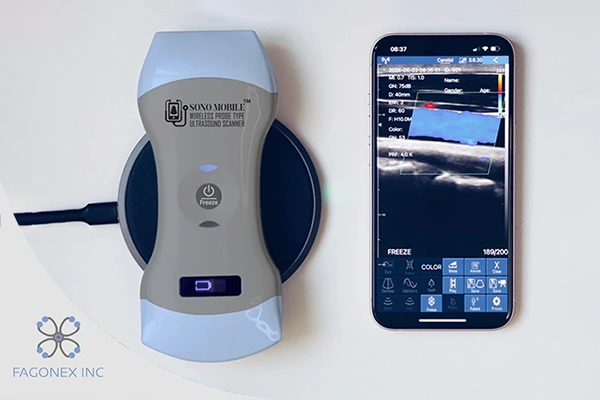
Over the past decade, handheld ultrasound technology has transformed from a supplementary diagnostic tool into a core component of modern clinical practice. Compact, wireless, and highly intuitive, devices such as Sono Mobile™️ now allow clinicians to bring advanced imaging directly to the patient’s bedside; whether in a crowded emergency department, a rural clinic, or an ICU operating at full capacity.
Point-of-care ultrasound (PoCUS) empowers physicians and trainees to make rapid decisions based on real-time imaging. Unlike traditional ultrasound systems, handheld devices require minimal setup, offer immediate scanning capability, and deliver impressive image quality across a wide range of applications. For hospital administrators seeking to improve workflow efficiency and for medical students looking to build essential diagnostic skills, handheld ultrasound represents a pivotal shift toward smarter, more accessible healthcare.
This article highlights the top nine medical specialties that benefit the most from handheld ultrasound, providing insights into how portable imaging enhances diagnostic accuracy, improves patient outcomes, and reshapes clinical workflows. Each section includes practical scenarios and real-world applications to illustrate the device’s value across diverse care environments.
9 Medical Specialties
Below are the nine leading fields in which handheld ultrasound has become indispensable; both as a primary imaging tool and as a supplement to traditional diagnostic systems.
1. Emergency Medicine
In emergency medicine, speed and precision are everything. Clinicians often face situations where every second matters, trauma evaluations, cardiac arrest, abdominal pain, respiratory distress, and shock are common presentations that require rapid imaging insight.
Handheld ultrasound provides emergency physicians with immediate access to the information they need to stabilize patients. With Sono Mobile™️, clinicians can begin scanning within seconds, without waiting for room availability or bulky cart-based machines.
Key Benefits in Emergency Medicine
- Rapid assessment of internal bleeding using FAST (Focused Assessment with Sonography for Trauma)
- Real-time evaluation of cardiac activity during resuscitation
- Quick identification of pericardial effusion, pneumothorax, and pleural fluid
- Non-invasive triage tool for hypotension or undifferentiated shock
- Immediate vascular access guidance
Clinical Scenario
A trauma patient arrives by ambulance with suspected intra-abdominal bleeding. Instead of waiting for radiology, the emergency team performs a FAST scan instantly using a handheld device, detects free fluid in Morison’s pouch, and expedites surgical intervention. This rapid response significantly improves survival outcomes.
2. Cardiology

Handheld ultrasound has revolutionized bedside cardiac assessment. Whether reviewing ejection fraction, assessing ventricular function, or screening for valvular abnormalities, portable devices enable cardiologists to perform targeted cardiac imaging during routine examinations.
Key Benefits in Cardiology
- Quick evaluation of left ventricular function
- Assessment of volume status and cardiac preload
- Immediate detection of pericardial effusion
- Ongoing monitoring of chronic cardiac conditions
- Early identification of heart failure exacerbations
Clinical Scenario
A cardiologist evaluates a patient with worsening dyspnea. Within moments, a handheld echocardiogram reveals reduced ejection fraction, allowing immediate adjustment of heart failure therapy. This avoids delays in imaging and prevents unnecessary hospital readmission.
Handheld ultrasound is especially valuable for cardiologists working in outpatient settings, providing continuous monitoring without scheduling limitations.
3. Obstetrics & Gynecology (OB/GYN)
OB/GYN physicians rely heavily on ultrasound, and handheld devices have become a vital extension of their workflow. From early pregnancy confirmation to gynecologic assessments, portable ultrasound improves access to essential imaging in clinics and remote locations.
Key Benefits in OB/GYN

- Early pregnancy evaluation and confirmation
- Quick fetal heartbeat assessment
- Identification of ectopic pregnancy
- Guidance for IUD placement or removal
- Visualization of ovarian cysts or uterine abnormalities
Clinical Scenario
A pregnant patient in a rural clinic presents with abdominal pain. The physician uses handheld ultrasound to confirm an intrauterine pregnancy and rule out ectopic risk; delivering immediate reassurance and avoiding unnecessary transfer.
The ease of use and mobility of Sono Mobile™️CT61 make it a preferred solution for prenatal outreach programs, midwives, and family medicine clinics providing obstetric care.
4. Primary Care
Primary care physicians are often the first point of contact for patients with undifferentiated symptoms. Handheld ultrasound enriches routine examinations and facilitates quicker referrals, diagnosis, and treatment.
Key Benefits in Primary Care
- Rapid assessment of abdominal pain, gallstones, or kidney issues
- Early detection of thyroid nodules or soft tissue abnormalities
- Guidance for injections and aspiration procedures
- Improved management of chronic diseases (e.g., heart failure, COPD)
Clinical Scenario
A family physician evaluates a patient with suspected gallbladder disease. Using a handheld device, the physician identifies gallstones during the appointment and accelerates surgical referral, reducing weeks of waiting and unnecessary diagnostic steps.
By integrating handheld ultrasound into routine visits, primary care providers can deliver more comprehensive care at a lower cost.
5. Anesthesiology
In anesthesiology, precision is essential for safe perioperative management. Handheld ultrasound devices support anesthesiologists in performing nerve blocks, vascular access, and airway assessments, reducing complications and enhancing patient safety.
Key Benefits in Anesthesiology
- Real-time guidance for peripheral nerve blocks
- Ultrasound-guided central and peripheral IV access
- Preoperative airway evaluation
- Improved success rate for spinal or epidural procedures
- Enhanced monitoring in postoperative recovery
Clinical Scenario
During a busy surgical day, an anesthesiologist uses Sono Mobile™️CL64 to perform an ultrasound-guided brachial plexus block in minutes. With precise needle visualization, the procedure is efficient, safe, and comfortable for the patient.
Handheld ultrasound ensures consistency and accuracy, especially in outpatient or ambulatory surgical centers.
6. Critical Care & ICU

Critical care environments demand fast, accurate information. Handheld ultrasound brings advanced imaging directly to the bedside; essential for patients who cannot be transported due to their unstable conditions.
Key Benefits in Critical Care
- Daily hemodynamic monitoring
- Lung scanning for ARDS, pneumonia, pleural effusion, or pneumothorax
- Assessment of fluid responsiveness through IVC evaluation
- Cardiac function assessment without leaving the ICU
- Rapid diagnosis of acute abdomen or vascular complications
Clinical Scenario
An ICU patient with sepsis becomes hypotensive. Using a handheld ultrasound, the intensivist assesses the IVC and cardiac function within seconds, determining whether the patient needs fluids, vasopressors, or inotropes. No delays, no transportation risks.
Handheld PoCUS is now considered a standard of care in modern ICUs due to its diagnostic speed and reliability.
7. Internal Medicine
Internal medicine specialists deal with a wide spectrum of diseases and rely heavily on accurate diagnostics. Handheld ultrasound enhances physical examinations, supporting earlier detection and improving chronic disease management.
Key Benefits in Internal Medicine
- Examination of liver size, spleen, ascites, or gallbladder
- Identification of DVT in outpatient settings
- Lung ultrasound for heart failure monitoring
- Thyroid and soft tissue imaging
- Support for guided procedures such as paracentesis
Clinical Scenario
A patient presents with worsening leg swelling. The physician uses handheld ultrasound to rule out deep vein thrombosis immediately; avoiding referral delays and reducing patient anxiety.
Internal medicine residents increasingly train with handheld ultrasound because it improves diagnostic confidence and builds strong foundational skills.
8. Pediatrics
Handheld ultrasound offers a gentle, radiation-free imaging option for children. Pediatricians value the ability to scan instantly, especially when working with infants and young children who may not tolerate long imaging procedures.
Key Benefits in Pediatrics
- Assessment of neonatal lungs and respiratory distress
- Identification of intussusception or pyloric stenosis
- Pediatric cardiac function screening
- Evaluation of dehydration through IVC measurement
- Guided vascular access in small or difficult veins
Clinical Scenario
In a pediatric emergency department, an infant presents with persistent vomiting. A handheld scan quickly identifies pyloric stenosis, allowing immediate surgical referral and preventing prolonged suffering.
Because portability minimizes the stress of moving children between departments, handheld ultrasound improves both diagnostic efficiency and patient experience.
9. Sports Medicine

Athletes and active individuals require fast evaluation of musculoskeletal injuries. Sports physicians use handheld ultrasound to diagnose injuries and guide treatments directly on the field or in the clinic.
Key Benefits in Sports Medicine
- Identification of muscle tears, tendon injuries, or ligament sprains
- Dynamic assessment while the patient moves
- Guidance for injections or PRP therapy
- Monitoring of injury healing progression
- Immediate sideline decision-making
Clinical Scenario
A soccer player collapses with suspected hamstring injury. The team physician uses handheld ultrasound to assess the muscle on the sidelines and makes the immediate decision to remove the player from the game; preventing further damage.
For rehabilitation centers and athletic teams, handheld ultrasound has become a crucial performance and safety tool.
Conclusion
Handheld ultrasound technology has emerged as one of the most important innovations in modern healthcare. Compact, wireless devices such as Sono Mobile™️ are reshaping clinical practice by providing real-time imaging, enabling rapid decision-making, and improving workflow efficiency across multiple medical specialties.
From emergency physicians managing trauma to cardiologists assessing cardiac function at the bedside, portable ultrasound delivers powerful diagnostic capability in a fraction of the time required by traditional systems. Hospital administrators can reduce operational costs and increase productivity, while medical students gain hands-on experience in essential PoCUS skills that are now fundamental to clinical training.
Each of the nine specialties highlighted; Emergency Medicine, Cardiology, OB/GYN, Primary Care, Anesthesiology, Critical Care, Internal Medicine, Pediatrics, and Sports Medicine; demonstrates how handheld ultrasound enhances patient care, optimizes outcomes, and supports the future of healthcare delivery.
Handheld devices are no longer optional. They are essential tools that bring imaging closer to the patient, empower clinicians with rapid insights, and elevate the standard of care across every level of medical practice.
If your institution is exploring the benefits of point-of-care ultrasound or you are a medical student seeking to develop core imaging skills, Sono Mobile™️ offers a versatile, cost-effective solution engineered for modern medicine.