
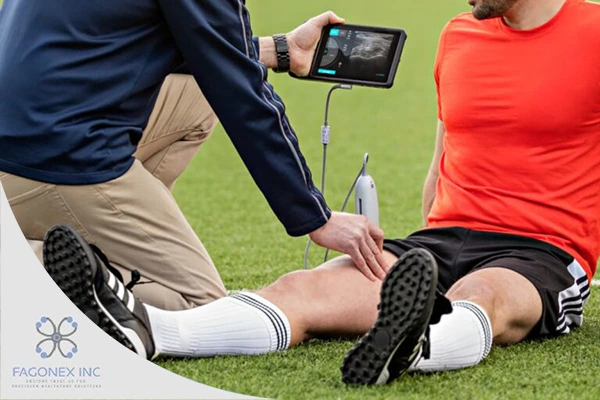
In the evolving landscape of modern medicine, speed, accuracy, and accessibility are no longer luxuries; they are necessities. Nowhere is this more evident than in sports medicine, where clinical decisions must often be made in seconds, not hours. Whether on the sidelines of a professional match or in a busy outpatient clinic, physicians are under increasing pressure to diagnose injuries quickly, guide treatment, and determine safe return-to-play timelines.
Handheld ultrasound devices have emerged as a transformative solution, redefining how clinicians approach musculoskeletal assessment. Compact, powerful, and highly versatile, these devices bring diagnostic imaging directly to the point of care. For hospital administrators and medical students alike, understanding the growing role of handheld ultrasound is critical; not only for improving patient outcomes but also for optimizing workflow efficiency and reducing healthcare costs.
Among leading innovations in this field, Sono Mobile™ represents a new generation of portable imaging solutions designed specifically for real-time clinical decision-making. As we explore the applications of handheld ultrasound in sports medicine, it becomes clear that this technology is no longer optional, it is essential.
What Makes Handheld Ultrasound Ideal for Sports Medicine?
Sports medicine is inherently dynamic. Injuries occur unpredictably, often in environments far removed from traditional imaging centers. This is where handheld ultrasound excels. It combines portability with advanced imaging capabilities, enabling clinicians to assess injuries instantly.
Unlike conventional imaging modalities that require scheduling, patient transport, and delayed reporting, handheld ultrasound delivers immediate insights. This aligns perfectly with the needs of sports physicians who must act quickly and confidently.
Additionally, handheld ultrasound supports the broader concept of point-of-care ultrasound (POCUS); a rapidly expanding practice across multiple disciplines. In fact, sports medicine is increasingly recognized among the best specialties for handheld ultrasound, alongside emergency medicine, anesthesiology, and critical care.
Portability and Speed
One of the most defining advantages of handheld ultrasound is its portability. Devices like Sono Mobile™ can easily fit into a pocket or small medical bag, allowing physicians to carry diagnostic capability wherever they go.
In sports settings, this translates into:
- Immediate sideline evaluations
- Rapid triage of injuries during competitions
- Reduced need for patient transport to imaging facilities
Speed is equally critical. Traditional imaging workflows can take hours or even days, particularly in busy hospital systems. Handheld ultrasound eliminates this delay, providing real-time visualization of soft tissues, joints, and vascular structures within seconds.
For hospital administrators, this efficiency means:
- Shorter patient wait times
- Improved throughput in clinics and emergency departments
- Reduced reliance on costly imaging infrastructure
Radiation-Free and Safe for Repeated Use
Safety is a cornerstone of any diagnostic tool. Unlike X-rays or CT scans, ultrasound uses sound waves rather than ionizing radiation. This makes it inherently safe for repeated use; an essential feature in sports medicine where athletes may require frequent monitoring.
This radiation-free nature is particularly valuable for:
- Young athletes with developing tissues
- Long-term injury follow-up
- Preventive screening programs
The benefits of handheld ultrasound in clinical practice extend beyond safety; they also include improved patient comfort and reduced anxiety, as imaging can be performed bedside without exposure to large, intimidating machines.
Real-Time Results Without Waiting for Radiology Reports
One of the most impactful advantages of handheld ultrasound is the ability to obtain and interpret results instantly. In traditional workflows, imaging studies are often sent to radiology departments, leading to delays in diagnosis and treatment.
With handheld ultrasound:
- Physicians can visualize injuries immediately
- Clinical decisions can be made on the spot
- Treatment can begin without delay
For sports teams, this can mean the difference between a player returning to the game safely or risking further injury due to uncertainty.
Common Sports Injuries Diagnosed with Handheld Ultrasound
Muscle Tears and Strains – Grading the Severity on the Spot
Muscle injuries are among the most common issues in athletes. Handheld ultrasound allows clinicians to:
- Identify muscle fiber disruption
- Detect hematomas
- Grade the severity of strains
This immediate assessment allows clinicians to make faster and more confident treatment decisions right at the point of care. By visualizing the injury in real time, physicians can determine whether the damage is mild, moderate, or severe. For example, a minor muscle strain may only require rest and gradual return to activity, while a more significant tear might need structured physiotherapy to restore strength and function. In cases where the findings are unclear or suggest a more complex injury, the physician can promptly refer the athlete for advanced imaging such as MRI. This targeted approach not only saves time but also reduces unnecessary tests and accelerates recovery planning.
Tendon Injuries: Achilles, Patellar, and Rotator Cuff Assessment
Tendons are particularly vulnerable in high-performance sports. Ultrasound provides high-resolution imaging of tendon structures, enabling detection of:
- Partial or complete tears
- Tendinopathy
- Calcifications
Real-time dynamic assessment is especially valuable, allowing physicians to observe tendon movement during function. This capability goes beyond simply taking a static image of the tendon. With real-time dynamic assessment, the physician can ask the athlete to move the affected joint; such as flexing the ankle or rotating the shoulder, while simultaneously visualizing the tendon on the screen. This allows them to see how the tendon behaves during actual movement, identifying subtle abnormalities that might not be visible at rest, such as partial tears, impingement, or abnormal gliding. It also helps differentiate between functional and structural problems. As a result, clinicians gain a more accurate understanding of the injury, leading to better-informed treatment decisions and safer return-to-play planning.
Ligament Sprains – Ankle, Knee, and Wrist Evaluation
Ligament injuries often require quick differentiation between mild sprains and more serious tears. Handheld ultrasound enables:
- Visualization of ligament integrity
- Detection of swelling and fluid accumulation
- Functional stress testing under imaging
This is crucial for determining whether an athlete can safely continue playing, as it directly impacts both short-term performance and long-term musculoskeletal health. In sports medicine, even minor injuries can worsen if an athlete returns to activity too early, leading to more severe tissue damage, prolonged recovery time, or chronic dysfunction. Using real-time imaging such as handheld ultrasound, physicians can objectively assess the extent of injury and reduce reliance on subjective pain reporting alone. This evidence-based approach supports safer clinical decisions, minimizes the risk of re-injury, and improves return-to-play protocols. For hospital administrators and sports organizations, this also enhances athlete safety, reduces liability, and ensures more efficient management of sports-related injuries in both professional and amateur settings.
Stress Fractures and Periosteal Reactions in High-Performance Athletes
While ultrasound cannot replace all aspects of bone imaging, it can detect early signs of stress injuries, including:
- Periosteal elevation
- Cortical irregularities
- Localized inflammation
This makes it a valuable screening tool, especially in endurance athletes, where repetitive strain and overuse injuries are common due to prolonged training loads and high-volume activity. In disciplines such as long-distance running, cycling, and triathlon, early detection of subtle tissue changes is essential to prevent progression into more serious conditions like stress fractures, tendinopathy, or chronic inflammation. Handheld ultrasound enables clinicians to perform quick, non-invasive evaluations during routine check-ups or training camps, improving preventive care strategies. From a sports medicine and performance optimization perspective, this proactive approach enhances athlete longevity, reduces downtime, and supports more personalized training programs based on real-time musculoskeletal assessment.
Joint Effusion and Hemarthrosis After Acute Trauma
Joint injuries often involve fluid accumulation. Ultrasound allows clinicians to:
- Detect effusions quickly
- Differentiate between simple fluid and blood
- Guide aspiration procedures if necessary
This immediate insight improves both diagnosis and intervention by enabling clinicians to make faster, evidence-based decisions directly at the point of care. In sports medicine and musculoskeletal assessment, real-time visualization of tissues allows physicians to accurately identify the type and severity of injury without unnecessary delays. This reduces diagnostic uncertainty and helps differentiate between conditions that require conservative management and those needing advanced treatment or imaging. As a result, patients receive more targeted and timely care, which can significantly enhance recovery outcomes. The benefits of handheld ultrasound in clinical practice include improved workflow efficiency, reduced healthcare costs, and better patient satisfaction. This approach is especially valuable in fast-paced environments such as emergency departments, sports clinics, and field-based medical care.
Nerve Entrapment and Soft Tissue Masses in Athletes
Nerve-related issues can significantly impact performance. Handheld ultrasound can identify:
- Nerve compression
- Swelling or inflammation
- Soft tissue masses such as cysts or lipomas
Dynamic scanning further enhances diagnostic accuracy by allowing clinicians to evaluate tissues in motion rather than relying only on static images. This is particularly important in musculoskeletal and sports medicine, where many injuries become more evident during movement or functional stress. By observing how tendons, ligaments, and muscles behave during contraction, extension, or joint rotation, physicians can detect subtle abnormalities such as partial tears, impingement, or abnormal biomechanics that might otherwise be missed. This real-time functional assessment improves diagnostic confidence and reduces the risk of misinterpretation. From a clinical workflow perspective, dynamic scanning supports faster decision-making, more precise treatment planning, and better monitoring of recovery progress over time.
Handheld Ultrasound on the Sideline: Practical Use Cases
Return-to-Play Decisions Supported by Real-Time Imaging
One of the most critical decisions in sports medicine is determining when an athlete can safely return to play. Handheld ultrasound provides objective data to support these decisions, reducing reliance on subjective assessment alone.
Monitoring Injury Recovery Between Training Sessions
Frequent imaging allows clinicians to track healing progress over time. This enables:
- Personalized rehabilitation plans
- Early detection of complications
- Optimized recovery timelines
Pre-Participation Screening for High-Risk Athletes
Preventive medicine is gaining importance in sports. Handheld ultrasound can be used to:
- Identify pre-existing conditions
- Detect asymptomatic abnormalities
- Reduce risk of future injuries
Handheld Ultrasound vs. MRI in Sports Injury Diagnosis
MRI remains the gold standard for many complex diagnoses, but it comes with limitations:
- High cost
- Limited availability
- Longer wait times
Handheld ultrasound, while not a complete replacement, offers several advantages:
- Immediate access
- Lower cost
- Dynamic, real-time imaging
In many cases, ultrasound serves as a first-line diagnostic tool, reducing the need for MRI or guiding more targeted imaging when necessary.
Choosing the Right Handheld Ultrasound for Sports Medicine
Selecting the appropriate device is critical for maximizing clinical benefits. Key factors to consider include:
- Image quality: High-resolution imaging is essential for musculoskeletal assessment
- Probe versatility: Linear probes are particularly important for superficial structures
- Software capabilities: Features like Doppler imaging enhance diagnostic accuracy
- Portability and battery life: Essential for field use
Devices like Sono Mobile™ L4 are specifically designed to meet these requirements, offering a balance of performance, portability, and ease of use.
For hospital administrators, investing in the right handheld ultrasound system can lead to:
- Improved patient satisfaction
- Enhanced clinical efficiency
- Reduced operational costs
For medical students, early exposure to this technology provides a significant advantage, as ultrasound skills are becoming increasingly essential across multiple specialties.
Conclusion
Handheld ultrasound is redefining the practice of sports medicine. By bringing imaging directly to the point of care, it empowers physicians to make faster, more accurate decisions; whether on the sidelines, in the clinic, or within hospital settings.
From diagnosing muscle tears and ligament injuries to guiding return-to-play decisions, the applications are vast and continually expanding. As one of the best specialties for handheld ultrasound, sports medicine stands at the forefront of this transformation.
The benefits of handheld ultrasound in clinical practice; including speed, safety, cost-effectiveness, and real-time insights, make it an indispensable tool for modern healthcare.
For forward-thinking institutions and aspiring clinicians, adopting technologies like Sono Mobile™ is not just an upgrade; it is a strategic move toward the future of medicine.